Inspiring ... Articles
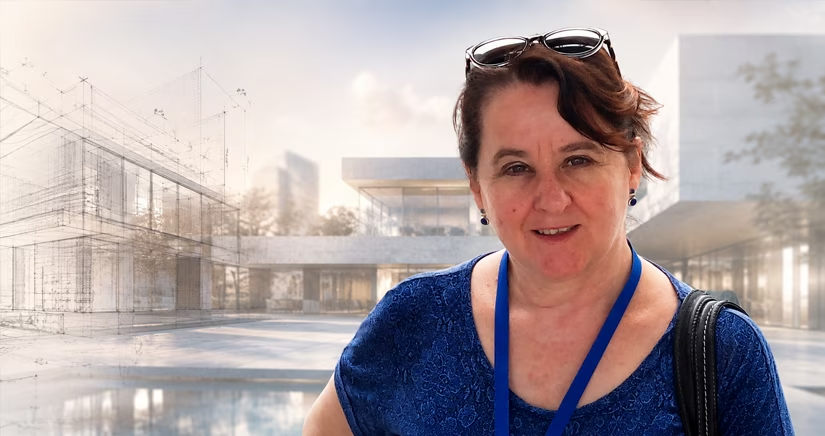
Professional Architect
SACAP Newsletter July/September 2020 ed 5 pages 50-51
1. Brief background about yourself?
I was born and raised in Welkom in the Free State to Italian immigrant parents and attended school at the Convent of St Agnes. I obtained my Bachelor of Architecture degree at the University of the Witwatersrand (Wits) and graduated with distinction in Architectural Practice winning the Farrow Laing Prize in Architecture for the Best Performance in Architectural Practice.
I completed the Management Advancement Programme at Wits Business School and became an arbitrator, registered as one of the youngest members of the South African Association of Arbitrators at the time.
My professional career encompassed working in several different size architectural companies such as Meyer Pienaar Smith Architects, Clive Bezer Architect, Moren Williams Lotter Forsythe Architects (MWLF) and Bentel Associates International (BAI) on many different building types and projects of all scales. These projects included luxury homes, service stations, warehouses, office buildings, shopping centres and hotels. During my time at BAI, I was the project architect for the mixed-use development Legacy Corner/ Da Vinci Hotel project in Sandton, Johannesburg. Fairly early in my career, I lectured at the Technikon of the Witwatersrand, where my interest in sustainable architecture was ignited.
My architectural practice was founded in Johannesburg, and based on green building and sustainable architecture principles. This passion led me to complete the Master of Architecture in Sustainable and Energy Efficient Cities at the University of the Witwatersrand. I have also presented on topics of leadership, creativity and sustainable cities internationally and locally.
2. Which architectural firm do you currently work for? and what is your role in the firm?
I currently run my own practice – MCP Architects & Arbitrators. I am the Founder and Managing Director. I am also an external examiner at Wits University and University of Johannesburg (UJ) and I am a member of the Gauteng Institute for Architecture (GifA) Practice Committee.
3. What influenced you to get into the architectural profession?
Looking back I think there were various influences – from my father who was a stone mason, my grandfathers who were builders, a love of drawing and art, an unforgettable visit to Versailles Palace in France that left an indelible memory of beautiful spaces which contrasted with the newly built Pompidou Centre that represented something so different from what I had ever seen. I also thought it would be an interesting profession, which it has been.
4. Name significant building projects that you have been involved?
The Legacy Corner/ Da Vinci Hotel project in Sandton, Johannesburg; Penthouses for the Legacy Corner/ Da Vinci project; Apartments for the Leonardo Development, Sandton, Johannesburg; Mimosa Mall refurbishment, Mangaung; Standard Bank, Blackheath, Johannesburg.
5. What are the key challenges that women in the architectural profession and the built environment face?
In a male dominated industry, women need to prove themselves especially on site. It isn’t a given that they are just as capable and knowledgeable as their male counterparts. Pay differences and glass ceilings still exist in the industry and since it’s still taboo to discuss salaries, it is difficult to determine if these differences do exist in the practice where you are employed. The “boys club” where decisions and projects are discussed over drinks still largely exclude women, leaving them at a disadvantage due to issues being discussed and perhaps even resolved in a forum to which they are not easily included. Balancing family and work life is also a challenge for working mothers as practices generally still have the view that family life shouldn’t intrude into work life.
This generally leans to the male dominated industry not making the necessary adjustments not only for women but for families as gender roles have changed. It is odd for me that architects who are at the forefront of innovation, have remained behind in terms of running their practices and the human resource issues that are prevalent at this point in time.6. Who is the architectural professional woman who inspires you?
Denise Scott Brown and Mira Fassler Kamstra because they are both trailblazers in the profession. Denise Scott Brown is an all-round accomplished architect as a designer, urban planner, writer, teacher, thought leader and campaigner for women architects. Mira Fassler
Kamstra has certainly led the way for women architects in South Africa and shown that not only can women be architects but that they can also be very good architects running their practices and contributing to the architectural landscape in South Africa as well.
7. Is there a distinct skill that women bring to the architectural profession and the built environment?
Their leadership style is more empathic and their design skills are more inclusive due to their experiences as care givers and nurturers.
8. Any guidance that you can give to young and aspiring architectural women?
Persevere and believe in yourself. Learn as much as you can about the profession and contribute wherever you can. Design is everywhere and you can bring a different perspective to how things are done. Diversify your skills and talents because it is an unpredictable profession with many ups and downs. Develop resilience with the knowledge that you can make things better.